
The Easypeasy guide
Accounting for ENK – Norwegian sole proprietorships, step by step
How to keep accounts for a Norwegian sole proprietorship: documents, invoicing, banking, VAT and tax returns. See practical examples and accounting software costs.
What accounting do you need to do for an ENK?
If you run a business as a Norwegian sole proprietor, you must keep accounts. You must document and record what the business buys and sells, keep track of payments and use the figures in reports to the authorities.
ENK stands for enkeltpersonforetak, the Norwegian term for a sole proprietorship, also commonly written as enkeltpersonsforetak. This guide shows how to organise your accounts when you work for yourself.
There is a difference between the obligation to keep books and the obligation to prepare annual accounts. Bookkeeping means recording and documenting transactions. Annual accounting obligations also require preparing annual accounts for the Register of Company Accounts. Small ENK businesses normally only have bookkeeping obligations; size and certain industries may create additional requirements.
Sources: The Norwegian Tax Administration on accounting and Altinn on annual accounting obligations.
How to keep accounts for an ENK, step by step
1. Collect documentation
Keep receipts and invoices when you buy something for the business. Note what the purchase is for if this is not clear from the document. A bank transaction shows the payment but does not replace documentation of the purchase itself.
As a general rule, documents must be retained for five years after the end of the financial year. Special rules may require longer retention. See Altinn's retention rules.
2. Record sales and purchases
Create the invoice when you sell, and record purchases with the correct date, amount and expense type. Check any VAT. Do not record the same purchase once from the receipt and again when the payment appears in the bank.
In Easypeasy, you can send invoices for free. The accounting plan also includes bookkeeping. The inbox integration helps you find documents; review the suggestions before approving them.
3. Match payments to the correct documents
When a customer pays an invoice, link the payment to the sale you have already recorded. The same applies when paying a supplier. This shows what has been paid and what remains outstanding.
If you used your personal card for a business purchase, the payment method must also be recorded correctly. Read about personal outlays for ENK.
4. Reconcile the bank and review your tasks
Compare your bank account with your books. Investigate missing documents, fees, duplicate entries and payments not linked to an invoice. The aim is to explain any differences and correct errors.
Use the checklist for doing your own accounting as a regular routine.
A simple ENK accounting example
Suppose you have completed a design job and bought materials for it. To illustrate how the figures connect, this example excludes VAT and other income or expenses, and assumes everything has been paid.
From income to profit
- Sale of design services
- NOK 10,000
- Materials used for the job
- − NOK 2,000
- Profit before tax
- NOK 8,000
The invoice documents the income. The receipt documents the purchase. The bank transactions show that the customer paid and that you paid for the materials. These three parts should match.
If you then transfer NOK 3,000 to your personal account, this is not a new operating expense. The profit in the example is still NOK 8,000. Money you withdraw for yourself must be kept separate from the costs of running the business. Read about finances and the owner's role in an ENK at Altinn.
VAT and income tax are different things
As a general rule, you must register the business in the VAT Register when VAT-liable turnover exceeds NOK 50,000 over twelve months. This is not a calendar-year threshold, and not all goods and services are subject to VAT. You must not invoice with VAT before the business is registered. Check the rules with the Norwegian Tax Administration.
The VAT threshold does not mean you can skip accounting below NOK 50,000. Bookkeeping and VAT registration are separate obligations.
The tax return contains information about both you and the business. The normal filing deadline for business owners is 31 May. You must file even if you had no turnover. How you file depends on factors including your obligations and the solution you use. See the Norwegian Tax Administration's guide for ENK.
To plan how much to set aside, you can use our free tax calculator for sole proprietorships. It provides a simplified estimate, including when you also earn a salary.
Which accounting software suits an ENK?
Choose software you understand in everyday use. Try recording a purchase, finding an invoice and checking which tasks remain. Also check the total cost of bank integration, invoice sending and tax returns.
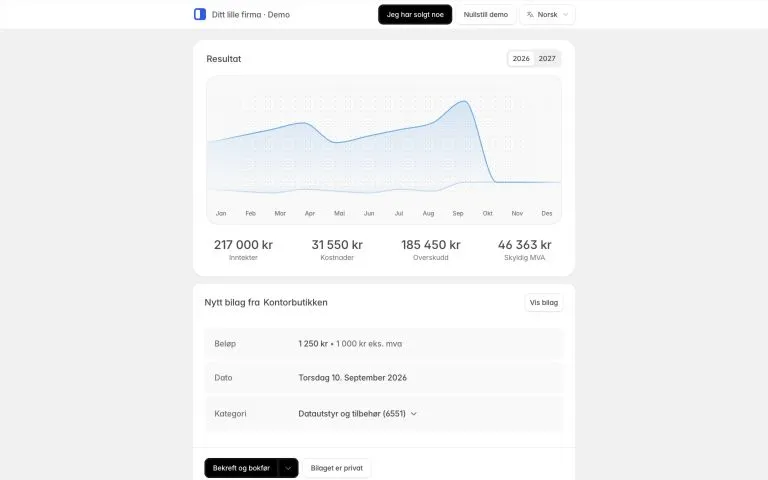
Easypeasy is built for sole proprietorships. The accounting plan costs 149 NOK per month excluding VAT and includes bookkeeping, bank integration and mileage tracking. The tax return is an optional add-on at 690 NOK per year excluding VAT.
You can compare accounting software and see what the different plans include. If you only need invoicing, you can send a free invoice.
Frequently asked questions about ENK accounting
Can I do my own accounting?
Yes. You can do it yourself, but you need to understand the rules and check that the information is correct. For complex matters, you can get help with all of your accounting or specific tasks. Altinn explains the responsibilities and routines.
Is free invoicing the same as free accounting?
No. Invoicing covers sales invoices. Complete accounts must also handle purchases, payments, reconciliation and reporting. Easypeasy has a free invoicing plan and a separate paid accounting plan.
Do I need a separate bank account for my business?
A separate account for business transactions makes it easier to stay organised. Check with your bank which account you can use for business. Altinn recommends separating business and personal finances.
What does “regnskap for enkeltpersonsforetak” mean?
It is a common Norwegian term for accounting for sole proprietorships, abbreviated ENK. The tasks are the same: documenting purchases and sales, following up on payments and submitting accurate information.
See how accounting can be simpler
Try Easypeasy with example data, or get started with your own sole proprietorship.